Ongoing Research. Expanding Evidence.
Scientific and clinical research on vibroacoustic therapy continues to evolve across neurological, rehabilitative, pain-management, and wellness settings. LifeTone Studio regularly curates and translates emerging research into accessible Evidence Spotlights to help clients, caregivers, and organizations better understand the growing body of evidence.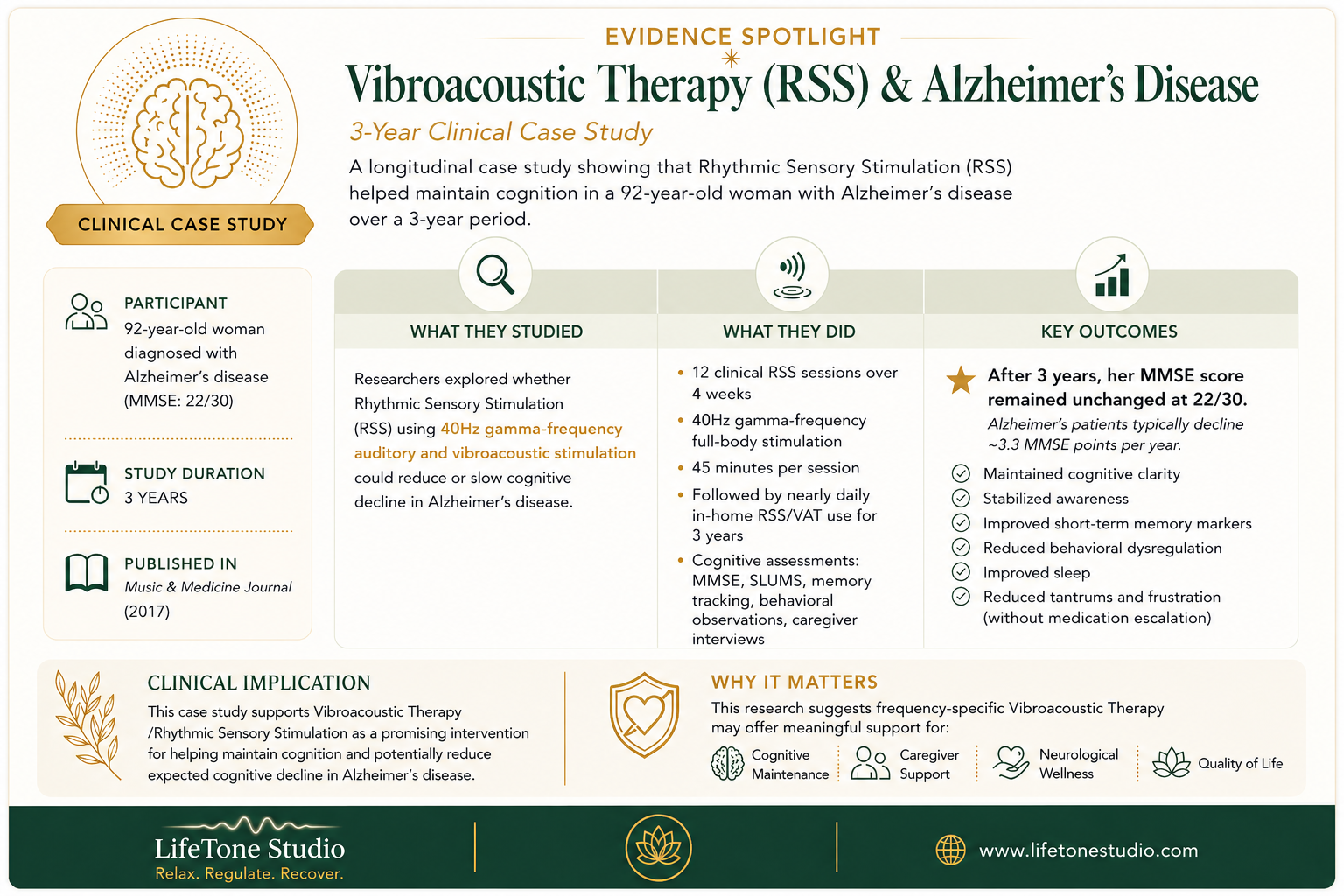
Vibroacoustic Therapy (40 Hz) & Alzheimer’s Dementia
LIFETONE EVIDENCE SPOTLIGHT
A 3-year longitudinal clinical case study investigating whether 40Hz gamma-frequency Vibroacoustic Therapy (Rhythmic Sensory Stimulation) could help maintain cognition and reduce expected cognitive decline in a woman diagnosed with Alzheimer’s disease.
-
Study Details
Study Type: Peer-reviewed longitudinal clinical case study
Participants: 1 (92-year-old woman with Alzheimer’s disease)
Frequency Used: 40Hz gamma-frequency stimulation
Study Duration: 3 years
Session Length: Initial 45-minute clinical sessions, followed by daily in-home use
-
Methodology
12 intensive clinical Vibroacoustic Therapy / RSS sessions over 4 weeks
40Hz full-body auditory + vibrotactile gamma stimulation
Initial sessions delivered in clinical setting
Followed by nearly daily in-home Vibroacoustic Therapy use for 3 years
Repeated cognitive and behavioral assessments conducted
Outcomes Measured:
MMSE (Mini Mental State Examination)
SLUMS cognitive testing
Memory assessments
Behavioral observations
Sleep
Caregiver interviews
Functional cognition tracking
-
Major Findings
After 3 years, her MMSE score remained stable at 22/30.
This is particularly significant because Alzheimer’s patients typically decline approximately 3.3 MMSE points annually.
Additional Reported Benefits:
Maintained cognitive clarity
Stabilized awareness
Reduced behavioral dysregulation
Improved sleep
Improved short-term memory indicators
Reduced frustration and tantrums
Sustained quality of life beyond expected progression patterns
-
This peer-reviewed longitudinal clinical case study supports Vibroacoustic Therapy / Rhythmic Sensory Stimulation as a promising modality for helping maintain cognition and potentially reduce expected cognitive decline in Alzheimer’s disease.
-
This research suggests frequency-specific Vibroacoustic Therapy may offer meaningful support for:
Alzheimer’s support
Cognitive maintenance
Caregiver support strategies
Neurological wellness
Behavioral regulation
Nervous system support
Long-term quality of life
-
Published In
Music & Medicine (2017)
DOI
10.47513/mmd.v9i3.565
Full Citation
Clements-Cortes, A., Ahonen, H., Evans, M., Tang-Wai, D., Freedman, M., & Bartel, L. (2017). Can Rhythmic Sensory Stimulation Decrease Cognitive Decline in Alzheimer’s Disease? A Clinical Case Study. Music & Medicine, 9(3), 174–177.
Research Access
Official journal abstract page / publication access: https://mmd.iammonline.com/index.php/musmed/article/view/565
LIFETONE EVIDENCE SPOTLIGHT
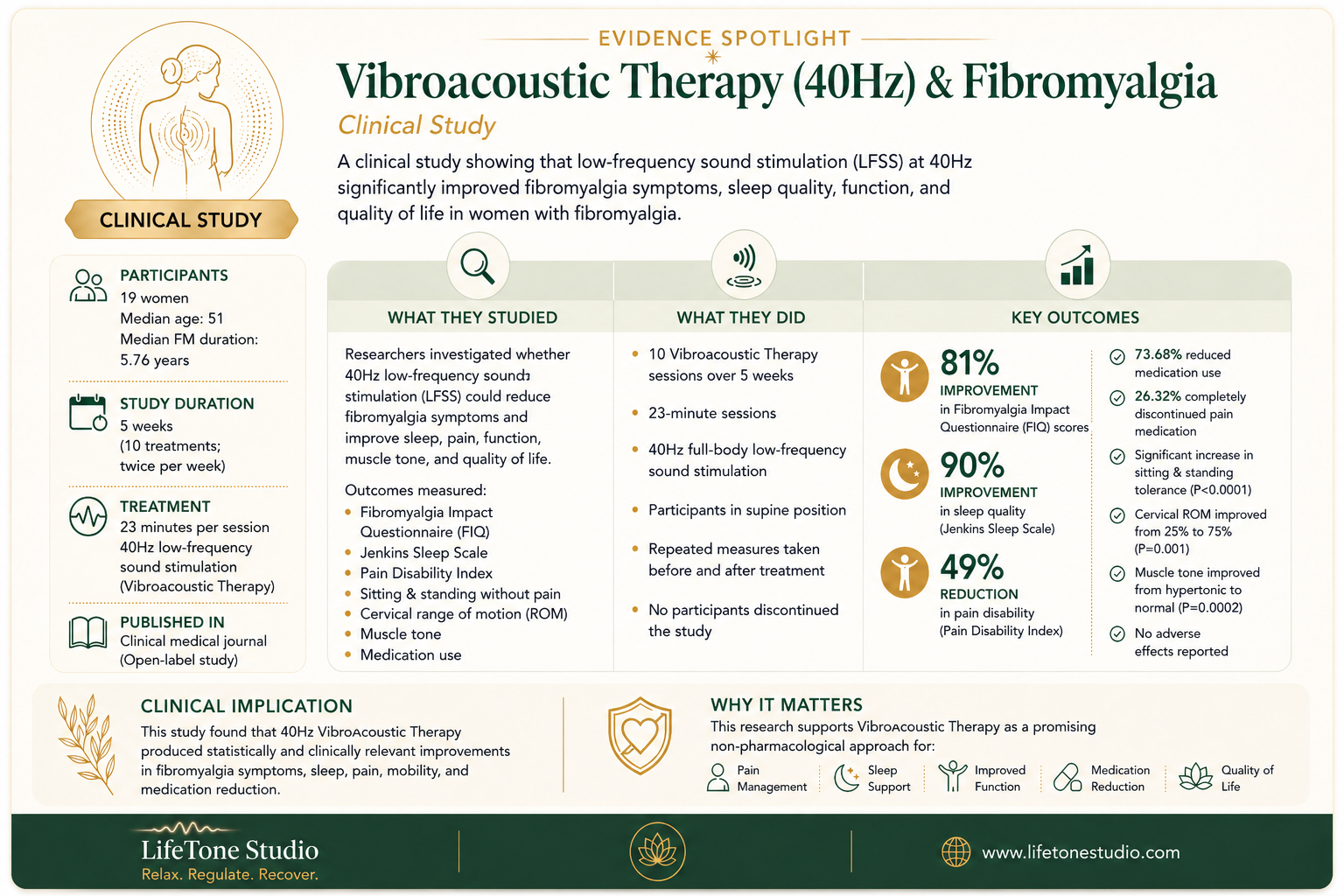
Vibroacoustic Therapy (40 Hz) & Fibromyalgia
A clinical study investigating whether 40Hz low-frequency sound stimulation (LFSS), a form of Vibroacoustic Therapy, could significantly reduce fibromyalgia symptoms, improve sleep, reduce pain, enhance function, and improve quality of life in women diagnosed with fibromyalgia.
-
Study Type: Peer-reviewed open-label clinical study
Participants: 19 women
Median Age: 51
Frequency Used: 40Hz
Study Duration: 5 weeks
Session Length: 23 minutes
-
Methodology
10 Vibroacoustic Therapy sessions over 5 weeks
Twice-weekly treatments
40Hz full-body low-frequency sound stimulation
Participants rested in supine position
Repeated measures taken before and after intervention
Outcomes Measured:
Fibromyalgia Impact Questionnaire (FIQ)
Jenkins Sleep Scale
Pain Disability Index
Sitting and standing tolerance
Cervical range of motion
Muscle tone
Medication use
-
Major Findings
81% improvement in Fibromyalgia Impact Questionnaire scores
90% improvement in sleep scores
49% reduction in pain disability
Additional Reported Benefits
Significant reduction in pain
Improved mood
Improved activities of daily living
Increased sitting tolerance
Increased standing tolerance
Improved cervical mobility
Reduced muscle hypertonicity
No adverse effects reported
73.68% reduced medication use
26.32% completely discontinued pain medication
-
This peer-reviewed clinical study found that Vibroacoustic Therapy produced statistically and clinically significant improvements in fibromyalgia symptoms, sleep, mobility, pain, muscle tone, and medication reduction, supporting its role as a promising non-pharmacological therapeutic intervention.
-
This research suggests Vibroacoustic Therapy may offer meaningful support for:
Chronic pain management
Fibromyalgia symptom reduction
Sleep support
Functional mobility
Medication reduction
Nervous system regulation
Quality of life enhancement
-
Published In
Pain Research and Management (2015)
DOI
10.1155/2015/981425
Full Citation
Naghdi, L., Ahonen, H., Macario, P., & Bartel, L. (2015). The effect of low-frequency sound stimulation on patients with fibromyalgia: A clinical study. Pain Research and Management, 20(1), e21–e27.
Research Access
Open-access full clinical article available via PubMed Central: https://pmc.ncbi.nlm.nih.gov/articles/PMC4325896/