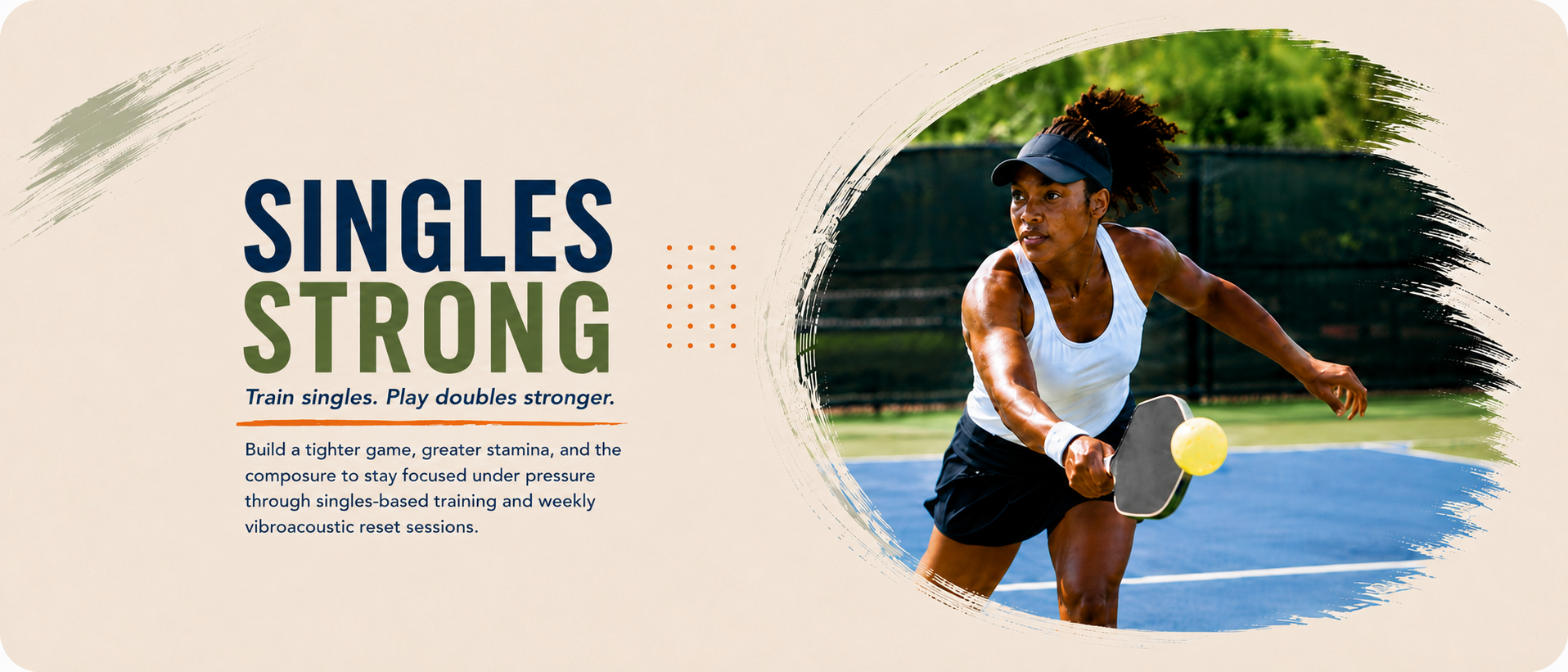
Build the game — and the composure — to hold your own court.
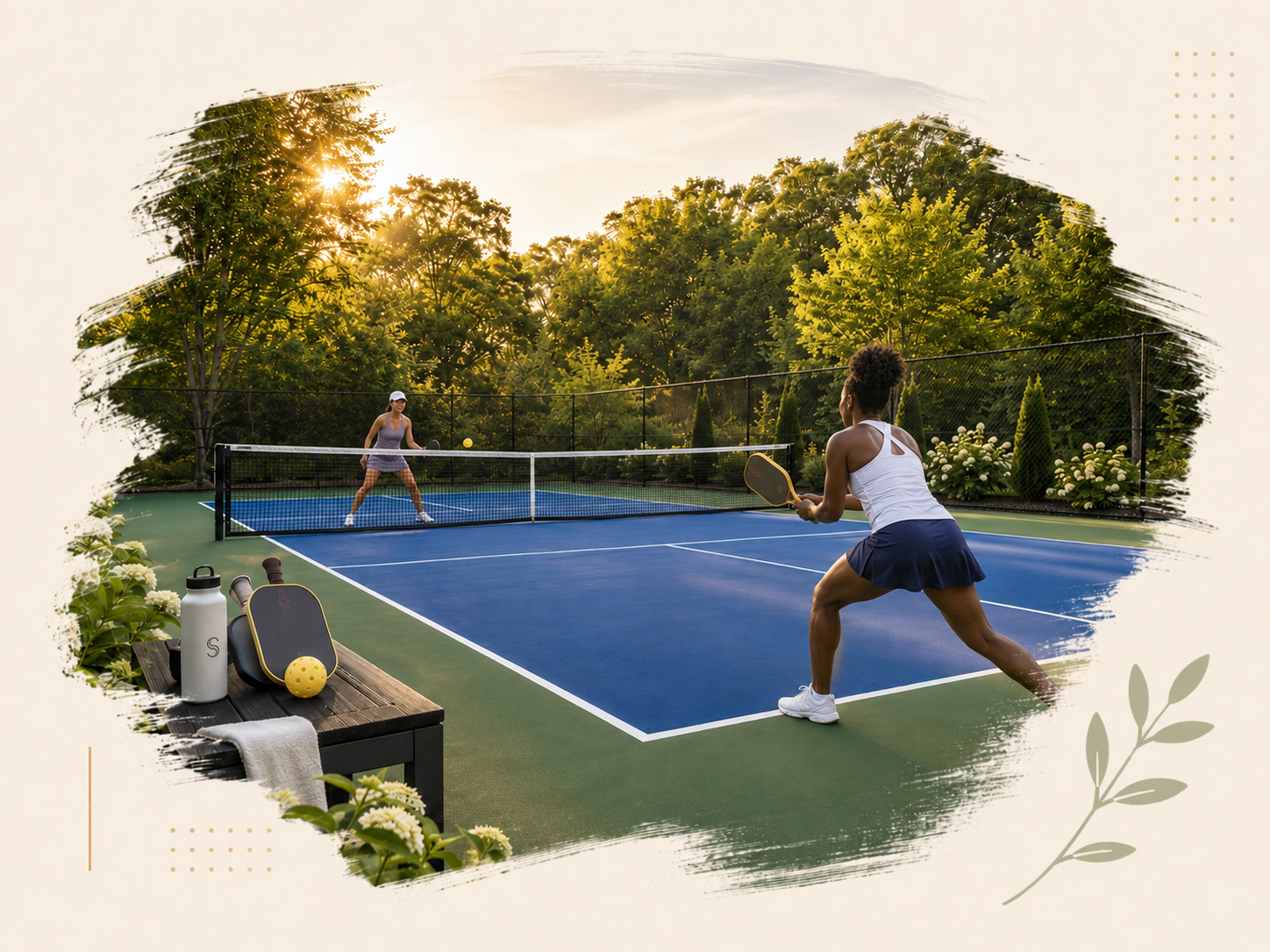
Singles can make you a stronger, more intentional pickleball player.
It can also feel intimidating.
There is no partner beside you to cover the open court, help change the momentum, or steady you after a mistake. Every shot, every decision, and every part of the court belongs to you.
For many developing players, that creates more than a physical challenge. It can bring anxiety, self-consciousness, rushed decisions, difficulty tracking the ball, and the fear of not being good enough to play singles.
Singles Strong helps you develop both your game and your response to the pressure of playing it.
What Is Singles Strong?
Singles Strong is a five-week, small-group training experience that combines on-court singles development with weekly vibroacoustic reset sessions.
The program is designed to help developing players:
move with greater purpose;
build stamina and court coverage;
make more intentional decisions;
recognize what happens to their game under pressure;
manage nervousness and frustration;
recover more quickly after mistakes; and
carry stronger skills and greater confidence back into doubles play.
You will not simply work on what to do with the ball.
You will begin learning what happens to your game when you become tired, anxious, rushed, frustrated, or uncertain—and what you can do next.
The Singles Strong Approach
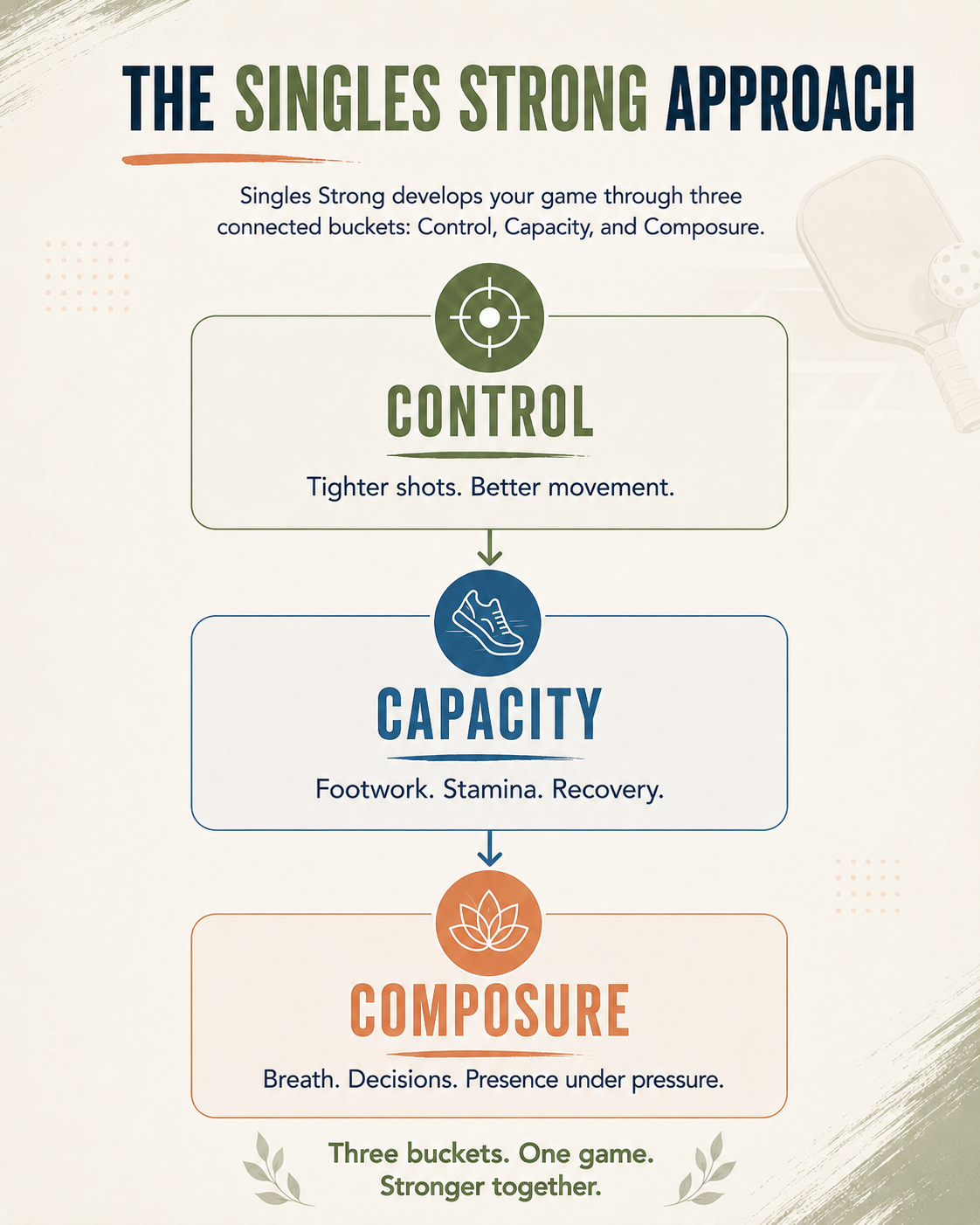
Learn to move with greater purpose, make more intentional choices, and manage the court instead of simply reacting to whatever comes next.
For many developing players, singles can feel chaotic. You may run toward every ball without recovering to a useful position, hit the first shot that comes to mind, or try to end the point before you have created the right opportunity.
You may be so focused on getting the ball back that you do not notice where your opponent is standing—or where the open court is.
Control training helps you slow the point down enough to see your options. You will work on tracking the ball, recovering after each shot, recognizing court position, and choosing shots that help you stay in the point rather than relying on speed or desperation.
Through movement patterns, point-building exercises, and guided play, you will practice using your feet, placement, and decisions together.
Control does not mean controlling every outcome. It means becoming more intentional about what you do with the ball, where you move next, and how you respond when the point does not unfold as planned.
CONTROL
Build the physical and mental endurance to continue moving, thinking, and making intentional decisions throughout the game.
Singles asks more of you physically because you are responsible for the entire court. As fatigue builds, you may stop recovering after your shots, reach instead of moving your feet, lose control of your placement, or rush the point because you want the rally to end.
Fatigue can also affect your thinking. The more tired you become, the harder it may be to track the score, recognize patterns, select the right shot, or recover emotionally after a mistake.
Capacity training helps you understand what happens to your game as the physical demand increases. You will practice efficient movement, court recovery, rally tolerance, and ways to reset between points so that tired does not automatically become hurried, careless, or defeated.
The goal is not simply to run more or endure longer. It is to build enough physical and mental reserve to remain connected to your game as the match becomes more demanding.
Capacity does not mean never becoming tired. It means learning how to continue moving with purpose, thinking clearly, and making useful choices even when you are no longer fresh.
CAPACITY
Learn to recognize how anxiety and pressure show up in your body, your thoughts, and your ability to follow the ball.
When you become anxious, everything can begin to move too quickly. You may tighten your grip, hold your breath, rush your shots, stop moving your feet, or struggle to track the ball because your attention is divided between the present point and everything happening in your head.
Composure training helps you slow things down internally so you can relax, follow the ball more consistently, and stay connected to the point in front of you.
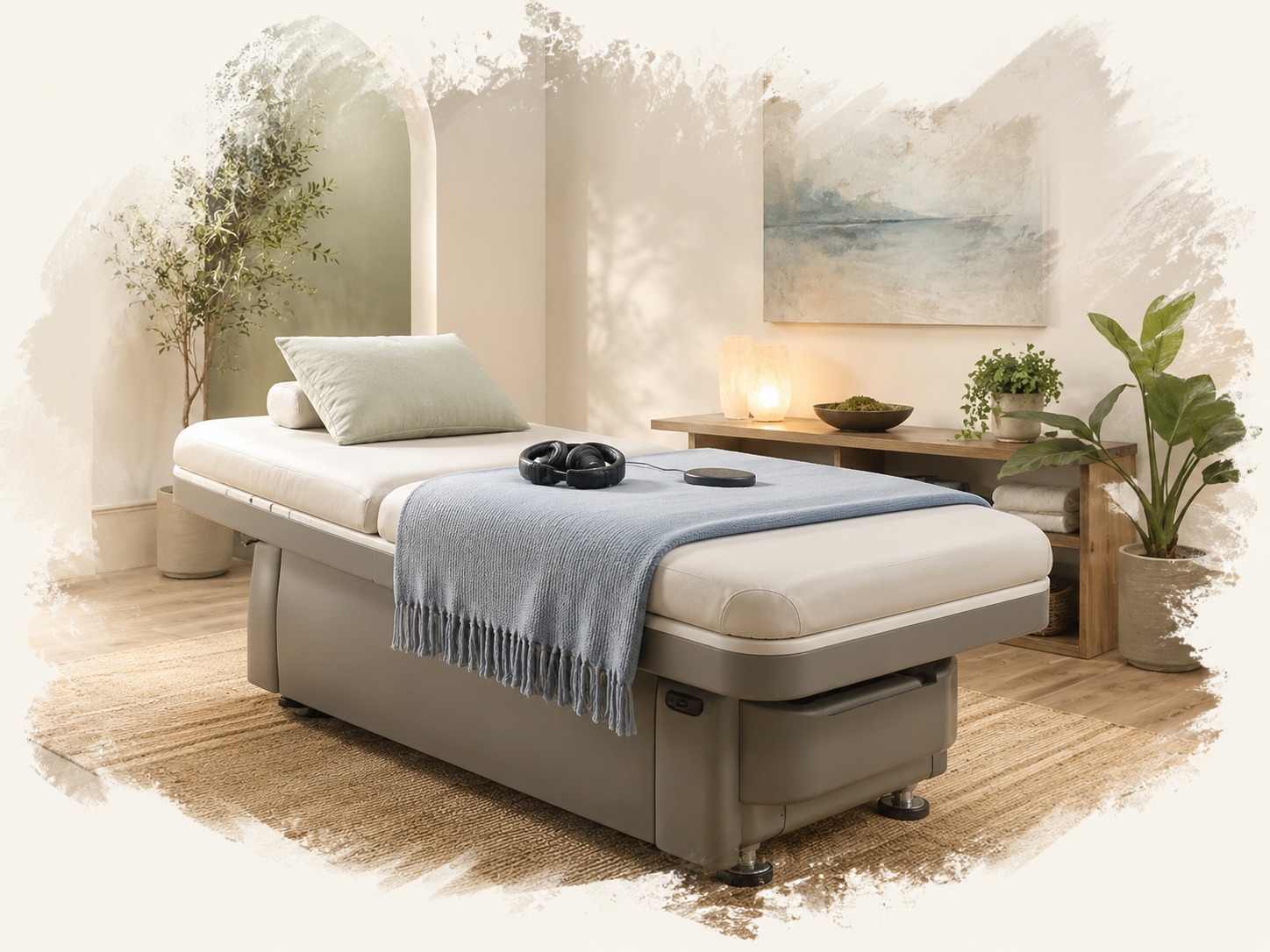
Part of the Composure element of Singles Strong is receiving a weekly vibroacoustic reset session—a gentle sound-and-vibration experience designed to support relaxation, regulation, and recovery.
COMPOSURE
“Usually when I play, I’m real anxious. I can’t focus. But I was able to relax, focus, and slow the ball down in my head.”
The experience of one pickleball player affirmed the potential of VAT to influence how we feel and respond on the court. She received a vibroacoustic reset session before returning to play pickleball. Afterward, she came back and described the difference she noticed:
Her experience raised an important question that Singles Strong gives players an opportunity to explore:
What becomes available in your game when your mind and body settle enough for you to see the ball, process what is happening, and respond with intention?
Through on-court awareness, ball-tracking exercises, between-point reset practices, and weekly vibroacoustic sessions, you will practice returning your attention to the ball, your body, and the point in front of you.
Composure does not mean never feeling nervous. It means learning how to slow the moment down, see the ball, and keep nervousness from making every decision for you.
A pickleball player describes what she noticed after receiving a vibroacoustic reset session and returning to the court.
Who is Singles Strong for?
Singles Strong is designed for early-stage and developing players who have basic stroke control but may not yet feel confident stepping onto a singles court.
It may be right for you if you want to:
understand how to cover the singles court;
move more efficiently and confidently;
improve your stamina;
develop a tighter, more intentional game;
learn what happens to your game under pressure;
manage nervousness, frustration, and negative self-talk;
recover more quickly after mistakes;
improve your ability to track the ball;
use singles to strengthen your doubles play; and
better understand what to practice next.
You do not have to consider yourself a singles player before joining.
You only need to be willing to learn what the singles court can teach you.
Why Include Vibroacoustic Reset Sessions?
A player’s game is affected by more than technique.
Stress, fatigue, muscle tension, frustration, and anxiety can influence movement, decision-making, confidence, ball tracking, and recovery.
A player may know what to do but struggle to access it once pressure builds.
The weekly vibroacoustic sessions create space for the body and mind to slow down, release tension, and recover from the physical and emotional demands of training.
These sessions support the larger Singles Strong goal:
Develop the skills to compete—and the ability to reset, recover, and return.
What Makes Singles Strong Different?
Most pickleball lessons concentrate primarily on strokes, drills, and strategy.
Singles Strong brings together:
skill development;
movement and stamina training;
pressure awareness;
ball tracking;
reflection;
nervous-system reset work; and
practical composure tools.
The program helps you understand not only what breaks down in your game, but also what may be happening inside you when it breaks down—and how to respond.
You may discover that what appears to be a technique problem is sometimes fatigue.
What appears to be poor judgment may sometimes be rushing.
What appears to be a lack of ability may sometimes be anxiety.
Singles Strong gives you an environment in which to notice those patterns and begin working with them.
What this is not.
Singles Strong is not an advanced singles academy, an all-in-one singles curriculum, or a quick-fix clinic.
It is also not mental-health treatment.
It is a focused, foundational training experience for players who want to better understand their game, strengthen their response to pressure, practice with intention, and continue developing after the program ends.
You can feel nervous and still step onto the court.
You can make a mistake and still play the next point.
You can become tired and still make an intentional decision.
You can feel the pressure and learn not to surrender your game to it.
The court is yours.
Learn how to hold it.
Join the Singles Strong Interest List
Be the first to receive information about upcoming Singles Strong groups, program dates, locations, pricing, and registration.
Train singles. Play doubles stronger.