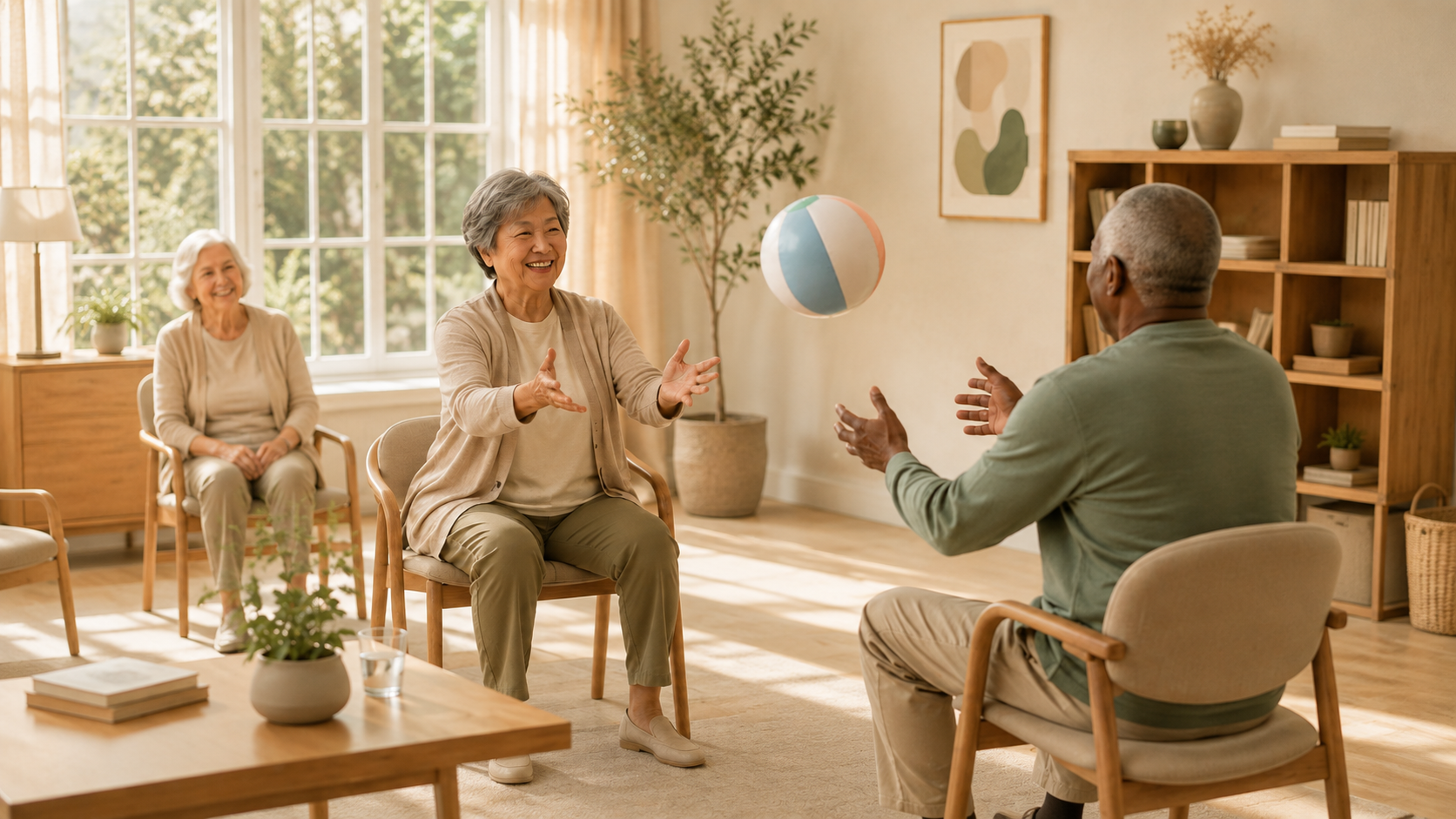
The Organizational Pathway
Could VAT add a meaningful new layer of support for the people and caregivers you already serve?
Your organization already carries important responsibility for people living with dementia and the families who care for them.
You may be looking for supportive options that can complement existing services, create more opportunities for calm and engagement, and offer families something meaningful beyond routine care alone.
LifeTone Studio partners with organizations to introduce dementia-focused vibroacoustic therapy through education, demonstrations, pilot programs, caregiver support, and thoughtfully designed service options.
VAT is not intended to replace medical care, clinical treatment, staff expertise, or the programs already in place. It is offered as an additional supportive resource—one that can be introduced gradually, evaluated carefully, and adapted to the needs and capacity of each organization.
The goal is partnership: to understand the people you serve, explore where VAT may fit, and build an approach that strengthens—not complicates—the care already being provided.
The Organizational Challenge
Organizations are being asked to do more—with limited tools, time, and capacity.
Families living with dementia are often searching for more than supervision, safety, and routine care. They want meaningful ways to support the person they love—especially when communication, participation, and connection begin to change.
At the same time, staff may have limited nonverbal tools for helping someone settle, engage, or respond when words and instructions are no longer enough.
Caregiver stress also remains high. Families may feel overwhelmed, uncertain, and increasingly helpless as the condition progresses.
Organizations need supportive programs that are:
credible and research-informed;
practical to introduce;
adaptable to different stages of dementia;
respectful of staff roles and existing care plans;
manageable within real space, staffing, and scheduling limits;
and capable of being evaluated before a larger commitment is made.
LifeTone’s organizational approach is designed around those realities. The goal is not to add another burdensome program, but to create a thoughtful, scalable way to explore whether dementia-focused VAT can strengthen the support already being provided.
Who LifeTone Partners With
Partnerships designed around the communities already serving people with dementia
LifeTone works with organizations that support people living with dementia, the families who care for them, and the professionals responsible for creating meaningful, practical care options.
Potential partners include:
adult day programs;
memory-care communities;
homecare agencies;
senior primary-care practices;
caregiver-support organizations;
churches and community groups;
senior centers;
dementia and aging organizations;
and healthcare-adjacent partners.
Each organization brings a different population, setting, and level of capacity. LifeTone does not assume that one model will fit every partner.
The first step is understanding:
who you serve;
what needs you are seeing;
what your staff and families are asking for;
what space, scheduling, and staffing realities must be considered;
and what level of involvement would be most useful.
From there, LifeTone can help identify an appropriate starting point, whether that is education, a demonstration, caregiver programming, a small pilot, or another form of collaboration.
Ways to Work With LifeTone
Flexible entry points for education, experience, and implementation
Organizations do not need to begin with a large program. LifeTone offers several ways to introduce dementia-focused VAT based on your goals, audience, space, staffing, and level of readiness.
Possible partnership options include:
Educational presentations
An introduction to vibroacoustic therapy, its relevance to dementia, the research behind the approach, and what families or staff may observe.Leadership or staff demonstrations
A direct experience for decision-makers or team members who want to understand how VAT feels, how it is delivered, and what implementation may require.Caregiver presentations
Educational sessions designed for families who want to learn about dementia-focused VAT and ask practical questions about participation.Community demonstration events
Brief demonstrations offered in a community setting to help attendees experience the modality and learn how it may fit within dementia support.
Small dementia-focused pilots
A defined program involving a limited number of participants, structured sessions, caregiver or staff observations, and a final review.Limited recurring onsite programs
Scheduled VAT services delivered onsite for a manageable number of participants over an agreed period.Caregiver wellness sessions
VAT experiences designed specifically to support the people carrying the physical and emotional demands of caregiving.Home-continuity education or referral pathways
Guidance for families interested in continuing VAT at home, including education, setup consultation, or referral into LifeTone’s family pathway.
The right starting point depends on what your organization is trying to solve. LifeTone works with each partner to identify an option that is useful, realistic, and appropriate for the people you serve.
Recommended Entry Points
A gradual path from introduction to implementation
LifeTone’s organizational partnerships are designed to develop in stages. This allows your team to understand the approach, experience VAT directly, and evaluate fit before committing to a larger program.
A typical pathway may include:
Introductory conversation
We begin by learning about your organization, the people you serve, the needs you are seeing, and the outcomes you hope to support.Decision-maker demonstration
Key leaders or staff members experience VAT firsthand and gain a clearer understanding of the equipment, session environment, and participant experience.Educational session
LifeTone introduces dementia-focused VAT to staff, caregivers, families, or other stakeholders and provides space for questions and discussion.Small pilot
A limited number of participants receive a defined series of sessions, with structured observation and caregiver or staff feedback.Review and next-step planning
At the end of the pilot, LifeTone and the organization review what was observed, what implementation required, and whether continued or expanded support makes sense.
The process is intentionally paced. Each step should provide enough information and experience to determine whether moving forward is appropriate for your organization.
The Dementia-Focused Pilot Model
A small, structured way to evaluate fit before expanding
A pilot gives your organization an opportunity to explore dementia-focused VAT with a manageable number of participants, within a defined period, before considering a larger or ongoing program.
The pilot is designed to answer two important questions:
How do participants respond?
Can VAT be delivered effectively within your organization’s actual environment and capacity?
A pilot may include:
A small participant group
A limited number of individuals are selected based on suitability, organizational goals, and available capacity.A defined time period
The pilot follows an agreed schedule and research-informed session framework, with enough repeated exposure to observe responses over time.Baseline information
Staff members, caregivers, or family members share relevant information about each participant’s usual communication, mood, engagement, comfort, routines, and current concerns.
Structured VAT sessions
Participants receive a defined series of sessions with adaptations based on mobility, comfort, communication, and stage of dementia.Staff or caregiver observations
Those who know the participants help identify changes that may appear after sessions or within daily routines.A final summary
LifeTone provides a review of participation, observed responses, recurring patterns, implementation considerations, and feedback gathered during the pilot.Capacity and feasibility review
LifeTone and the organization consider the practical realities of space, equipment, staffing, scheduling, participant flow, and the level of service that could be sustained.
A pilot is not designed to prove that every participant will respond in the same way. It provides a thoughtful, contained process for determining whether VAT appears meaningful for the participants and workable for the organization.
Pilot Tracking and Reporting
What LifeTone Tracks and Reports During a Pilot
Throughout a pilot, LifeTone tracks both participant response and the practical realities of delivering the program. The purpose is to understand what occurred during the pilot, what patterns may be emerging, and what would be required to continue responsibly.
What LifeTone Tracks During A Pilot
Tracking may include:
Participation and session response
Attendance, session completion, comfort, positioning, tolerance, and notable responses during or immediately after sessions.Calm, engagement, and responsiveness
Observed changes in settling, attentiveness, interaction, conversation, mood, energy, or participation.Staff and caregiver observations
Feedback from people who know the participants and may notice changes after sessions or within familiar routines.Implementation considerations
Space, equipment, scheduling, participant transitions, staffing, accommodations, and participant flow.Patterns across the pilot
Repeated or meaningful observations that appear across sessions, participants, or the delivery setting.
What The Organization Receives
At the conclusion of the pilot, LifeTone provides a program-level review based on the information gathered throughout implementation. Reporting may include:
number of participants enrolled;
attendance and completion rates;
number and frequency of sessions delivered;
overall comfort and tolerance patterns;
general categories of responses observed;
staff or caregiver feedback gathered through the agreed process;
common positioning or accommodation needs;
practical findings related to space, scheduling, staffing, equipment, and participant flow;
patterns observed across the pilot;
overall feasibility;
and recommendations for continuation, adjustment, expansion, or further evaluation.
The report may state, for example, that several participants showed increased settling, engagement, or responsiveness across repeated sessions. It would not ordinarily include a named participant’s personal history, detailed conversation, caregiver comments, or session-by-session experience.
The final pilot report is intended to support a thoughtful next-step decision—not to overstate what a limited pilot can prove. It gives the organization a clearer basis for deciding whether dementia-focused VAT should be continued, adjusted, expanded, or concluded.
General Documentation, Privacy, and Information-Sharing Approach
How LifeTone handles participant information across services
The pilot reporting section explains what LifeTone tracks during a pilot and what the organization receives at the conclusion of that pilot.
This section addresses something broader: LifeTone’s general approach to participant documentation, privacy, and information sharing across organizational partnerships and individual services.
LifeTone may maintain a separate record for each participant receiving VAT. These records support the individual participant’s LifeTone pathway and are not automatically included in reports provided to an organization.
Participant-specific documentation may include:
baseline information provided by the participant, caregiver, or authorized representative;
attendance and session participation;
comfort, positioning, and tolerance;
practitioner observations during sessions;
caregiver-reported changes between sessions;
patterns that may emerge over the participant’s series;
and recommendations related to continued participation.
Individual observations may be reviewed with:
the participant;
the participant’s caregiver;
an authorized family representative;
or another approved person involved in the participant’s support.
Identifiable information is shared with an organization only when that sharing is necessary to the partnership, clearly defined, and appropriately authorized in advance.
When limited individual information is needed for care coordination or direct service delivery, LifeTone and the organization establish:
what information may be shared;
who is authorized to receive it;
why it is being shared;
how permission or authorization will be obtained;
and how the information will be stored and protected.
This general approach applies beyond a single pilot. It helps ensure that participant-specific records, organizational reporting, and any necessary care-coordination information are handled as distinct forms of documentation rather than combined automatically.
LifeTone separates individual participant records from organizational reporting so that each person’s experience can be documented responsibly while their personal information remains protected.
Capacity and Delivery Options
Flexible delivery designed around your organization’s capacity
LifeTone recognizes that organizations vary in space, staffing, participant needs, scheduling, and readiness. VAT services can be introduced at a level that is practical for your setting and expanded only when the organization has the capacity to support it well.
Possible delivery options include:
Studio-based referrals
Organizations may refer appropriate individuals or families to LifeTone Studio for participation in the family pathway.Mobile or onsite sessions
LifeTone may provide VAT within the organization’s setting when space, power, privacy, scheduling, and participant support can be appropriately arranged.Small cohorts
A limited number of participants may receive a structured series of sessions over a defined period.Rotating participation
When demand exceeds immediate capacity, participants may be scheduled in rotating groups or sequential cohorts.
Education-only partnerships
Organizations may begin with presentations, caregiver education, staff training, or demonstrations without immediately offering participant sessions.Home-continuity support
Families of appropriate participants may be referred for guidance on continuing VAT at home, reducing the need for the organization to provide every session directly.Future scalable models
As LifeTone develops additional capacity, organizations may have access to more repeatable delivery structures, training, equipment consultation, or expanded partnership models.
The goal is not to force a large program into a setting that cannot sustain it. LifeTone works with each organization to identify a delivery model that is meaningful for participants, manageable for staff, and realistic over time.
Why LifeTone
Dementia-focused VAT delivered with care, structure, and purpose
LifeTone Studio brings together specialized focus, research-informed practice, lived caregiver experience, and careful observation to support people living with dementia and the organizations that serve them.
Organizations partner with LifeTone because the approach includes:
Dementia specialization
Dementia is the central focus of LifeTone’s work, not simply one condition among many.A research-informed approach
Session structure and protocol decisions are guided by the available dementia and 40 Hz research, while remaining responsive to the needs of each participant and setting.Certified VAT practice
LifeTone is led by a Certified Vibroacoustic Therapy Practitioner trained in the therapeutic use of low-frequency sound vibration.A caregiver perspective
LifeTone’s work was shaped through direct experience caring for a loved one with dementia. This brings practical understanding of the questions, fears, responsibilities, and hopes families carry.Structured observation and feedback
LifeTone looks beyond whether a participant appeared relaxed. Sessions may include baseline information, practitioner observation, caregiver or staff feedback, and review of patterns over time.Flexible equipment and delivery options
VAT may be offered through studio-based referrals, mobile or onsite sessions, adapted table or chair setups, small cohorts, and home-continuity support where appropriate.Human-centered implementation
The participant remains a person—not a diagnosis, data point, or program outcome. Comfort, dignity, individuality, and relationship guide how services are introduced and delivered.
LifeTone’s goal is to help organizations add a meaningful supportive option without losing sight of the individual people and families at the center of the work.
Your Questions, Answered
-
Space requirements depend on the delivery format and equipment used. Onsite VAT generally requires a quiet, private or semi-private area with enough room for the treatment table, chair, or adapted setup; safe participant entry and exit; and access to a standard electrical outlet. LifeTone reviews the proposed space before confirming onsite services.
-
Participation depends on the program format, available equipment, session length, schedule, staffing, and participant needs. A pilot usually begins with a small number of participants so that sessions can be delivered consistently and responses can be observed carefully. Larger groups may be served through rotating or sequential cohorts rather than all at once.
-
Some organizational involvement is generally necessary, but the level varies. A staff liaison may help coordinate scheduling, participant transitions, space access, and communication with caregivers or authorized representatives. Programs involving participants who need mobility, behavioral, or personal-care support may require more direct involvement from the organization’s staff.
-
Pilot pricing is determined by the number of participants, number and length of sessions, location, equipment and travel requirements, staffing needs, documentation, and final reporting. LifeTone develops a defined scope and price after the introductory conversation rather than using one standard pilot price for every organization.
-
Participant selection is collaborative. LifeTone and the organization consider the program’s goals, each person’s comfort and positioning needs, ability to participate safely, caregiver or representative involvement, and any information needed to determine suitability. Participation is not limited to one stage of dementia, but the setup and expectations may differ by individual.
-
LifeTone maintains participant-specific records for its service delivery. Organizational clients generally receive aggregate or de-identified program reporting, such as enrollment, attendance, completion, overall response patterns, implementation considerations, staff or caregiver feedback gathered through the agreed process, and recommendations for continuation or adjustment.
Identifiable participant information is shared only when the program structure requires it and the appropriate permissions have been established.
-
Yes. Caregivers may participate through educational sessions, baseline interviews, between-session observations, review conversations, wellness sessions, or home-continuity planning. Their involvement can provide important context about whether a participant’s response continues beyond the VAT session.
-
VAT may be adapted for people at different stages of dementia, from individuals who remain verbal and aware of cognitive changes to those who communicate less or require greater physical support. Suitability, positioning, session length, intensity, observation methods, and expected forms of response are considered individually.
Ready to Explore Dementia-Focused VAT for Your Organization?
LifeTone begins by understanding where dementia support currently fits within your organization—and where there may be unmet needs, service gaps, or opportunities to add something meaningful.
That conversation can help clarify whether the right next step is education, a demonstration, a small pilot, caregiver support, participant services, or simply continued exploration.
Not ready to discuss a partnership?
Still learning about the modality?