VAT + guided mobility + progressive strengthening
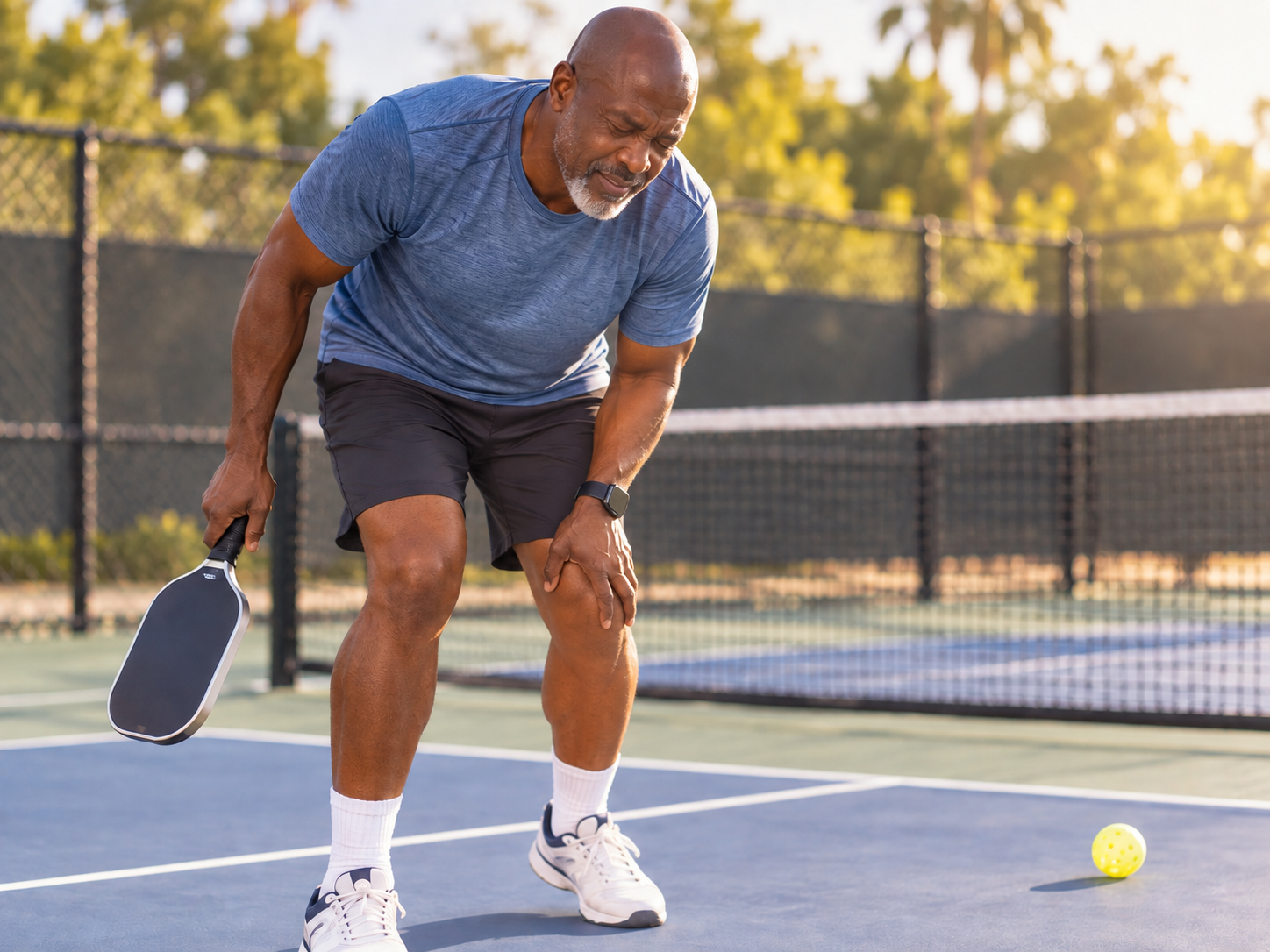
Knee pain and stiffness can change how you move on the court.
You stop getting as low.
You hesitate before changing direction.
You move less because movement hurts.
And over time, less movement can mean less strength, less mobility and less confidence.
Move Again is designed to help you get moving again...with less pain and greater knee strength.
We use Vibroacoustic Therapy (VAT) to help address pain, and the Knees Over Toes Guy approach to build mobility and knee strength.
VAT helps create a more comfortable doorway into movement. The ATG-based exercises provide the progressive work that builds physical capacity.
Together, they form a practical approach to helping you move better on and off the pickleball court.
My role is to help you:
start appropriately
understand the movements
stay accountable,
progress the work and
measure whether it is helping.
VAT → MOVE → STRENGTHEN → PLAY!
The Move Again Program
A 6-week guided mobility program.
You receive:
6 weekly 23-minute therapeutic VAT sessions
1 in-person initial mobility assessment
4 virtual mobility + accountability check-ins
1 in-person final assessment
Your individualized starting movement plan
Weekly exercise progression
Pain, mobility and functional progress tracking
Week 1: VAT + in-person assessment
Weeks 2–5: VAT + 15-minute virtual check-in
Week 6: VAT + in-person final assessment
The rhythm is simple.
You do the movement work between sessions.
I help you start at the right level, stay accountable, progress the work and see whether your mobility is actually changing.
Be Part of the First Move Again Pilot
I’m looking for 10 pickleball players with knee pain, stiffness, or limited mobility who are willing to commit to six weeks of consistent work.
Pilot Investment: $150
The six therapeutic VAT sessions alone represent $450 at current LifeTone Studio rates.
I’m substantially subsidizing this first cohort because I need participants who will help me test the model.
This is an opportunity to receive the complete six-week program at a reduced price while helping me evaluate how well the approach works and what needs refining before I offer it more broadly.
Your Commitment Matters
I’m asking each pilot participant to:
Show up. Do the work between sessions. Allow me to track your progress. Give me honest feedback.
Your experience will help me evaluate Move Again's efficacy, understand which components are most useful, and determine how the program should evolve.
10 Pilot Spots Available
Start Where You Are
There is no single starting point.
For one person, backward walking may mean ten minutes.
For another, it may mean five supported steps.
A squat may be appropriate for one player.
Another may begin with standing from a chair.
We start with what your body can do now.
Then we build.
Your initial assessment helps us establish that starting point and identify one meaningful area you want to improve over the next six weeks.
Use VAT to Open the Door
A look at how LifeTone Studio delivers Vibroacoustic Therapy across different settings — from pickleball events to in-studio and at-home sessions.
We begin with Vibroacoustic Therapy, using low-frequency sound that is both heard and gently felt through the body.
VAT is used to help address pain, tension and regulation before movement begins.
The purpose is simple:
Make movement more accessible before asking your body to work.
Build the Movement
Much of the exercise progression is based on the Knees Over Toes Guy approach developed by Ben Patrick.
The work may include:
Backward walking or stepping
Tibialis strengthening
Calf strengthening
Ankle mobility
Progressive knee flexion
Sit-to-stand work
Squat and split-squat progressions
Lower-body strengthening through increasing ranges of motion
Backward walking is one of the foundational movements.
Research in people with knee osteoarthritis has shown improvements in pain, function, stability, proprioception, and walking ability when backward walking is incorporated into rehabilitation.
The goal is not to push through pain.
The goal is to increase what your body can comfortably do.
Stay Accountable
Knowing what to do and doing it consistently are two different things.
During Weeks 2–5, we meet virtually for a focused 15-minute mobility + accountability check-in.
We review:
What you completed
How your knees responded
What became easier or harder
What needs to stay the same, change, or progress
Then you leave knowing exactly what to work on before the next session.

Track the Results
We want to know more than whether you feel better.
We want to know whether you are moving better.
At the beginning and end of the six weeks, we measure:
Normal daily knee pain
Pain after pickleball
Next-day pain and stiffness
Your primary functional goal
5x Sit-to-Stand
Timed Up and Go
Comfortable knee movement
A pickleball movement connected to your goal
During the weekly check-ins, we track how your pain is responding, whether you're doing the exercises consistently, what is becoming easier, and whether your program needs to be maintained, modified, or progressed.
Is your starting point changing?
Can you stand more easily?
Walk farther?
Bend farther?
Do more repetitions?
Move with more confidence?
Reach balls you used to give up on?
Do something that was difficult six weeks ago?
THAT IS PROGRESS.
Progress Toward Pickleball
The exercises are not the destination.
The court is.
As your strength and mobility improve, we connect the work to the movements pickleball requires:
Getting lower
Moving forward and backward
Changing direction
Pushing off
Recovering after a shot
Reaching more balls
Playing with greater confidence
Build more capacity for the way you actually want to move.
The Research Behind the Approach
The major pieces of Move Again are supported by research.
VAT + Pain
Low-frequency vibroacoustic stimulation has been studied for pain management, relaxation and regulation.
Exercise + Knee Pain
Exercise and strengthening are strongly supported for improving pain and function in knee osteoarthritis.
Backward Walking
Clinical studies have shown improvements in pain, mobility, stability and function.
Progressive Strengthening
Building strength through gradually increasing ranges of motion improves lower-body capacity and function.
Want to see more of the research?